The kapok tree is a rainforest giant, growing as much as 13 feet per year and reaching up to 200 feet tall. It is self-sufficient, with a naturally bitter antibacterial and antimicrobial fibre that eliminates the need for chemical pesticides. Kapok trees are also perfect for their neotropical climes, and artificial watering is unnecessary.
Like all plant wools, kapok fibre boasts much lower carbon emissions than wool taken from animals. One kilo of kapok generates 5.51 kilograms of CO2 equivalent, compared to up to 89.1 kilograms of CO2 equivalent for each kilogram of sheep’s wool.
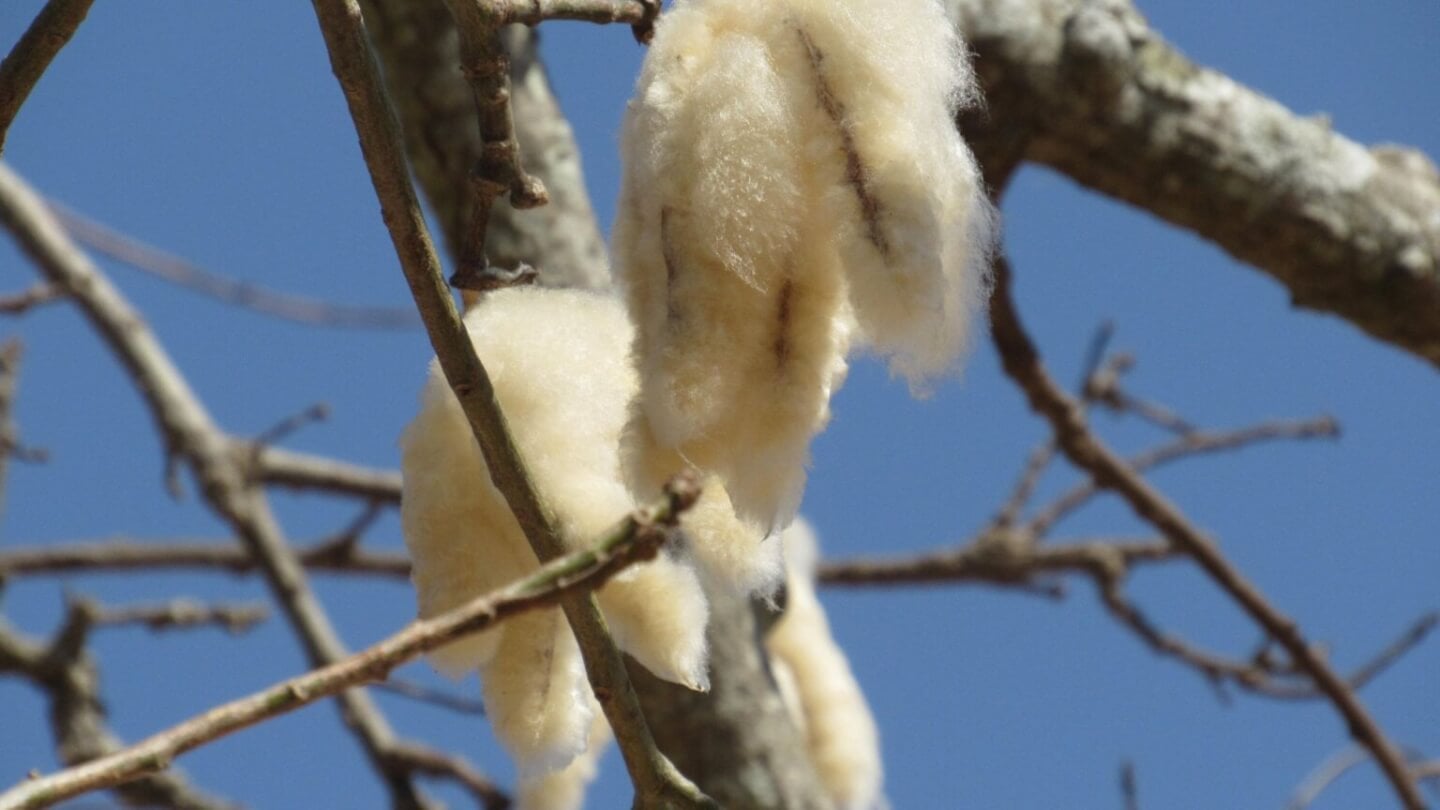
Kapok trees produce a soft, silky fibre that has the fluffy feel of down feathers without any of the cruelty. As a yarn, kapok is not used alone but rather blended with other fibres to make yarn that can be combined with other fibres to offset their impact and bring additional warmth, flexibility, and anti-moth properties. As a blending fibre, kapok adds minimal weight because its hollow core makes it eight times lighter than conventional cotton!
Utilising kapok is the mainstay of Flocus™, a company that makes textile fibres from the yarn for use in clothing such as knits, outerwear, homewares (including bedding), and more.
A Material Innovation Initiative report, which outlined next-generation replacements for wool, highlighted Flocus™’ work with kapok, and fashion brand Muji has embraced kapok blends to create diverse collections.
Read more: Discover Emerging Plant Wools